
Calibration is the process of adjusting a heat press controller to ensure the displayed temperature on the digital console matches the actual heat energy being emitted by the heating platen. It involves measuring the physical temperature of the platen with a certified device and offsetting the machine’s internal sensor (thermocouple) to correct any discrepancies.
Read more
Why It Matters: Impact and Use
In professional garment decoration, precision is the difference between a high-quality product and a failed transfer. Proper calibration is a cornerstone of E-E-A-T (Expertise, Authoritativeness, and Trustworthiness), as it ensures the shop can guarantee the technical specifications required by film and foil manufacturers.
- Consistency Across Multiple Machines: For shops running multiple presses, calibration ensures that “Press A” and “Press B” produce identical results using the same settings, which is vital for large-scale production (indexing) and quality control.
- Prevention of Transfer Failure: Most modern transfers (like DTF or High-Pressure Flex) have a narrow “success window.” Being off by as little as 5°C – 10°C can lead to poor adhesion, colors that aren’t vibrant, or designs that peel after the first wash.
- Avoidance of Fabric Damage: Overheating delicate synthetic fabrics like polyester or nylon can cause permanent “scorching” or “shining.” Calibration ensures you aren’t accidentally pressing at a higher temperature than indicated.
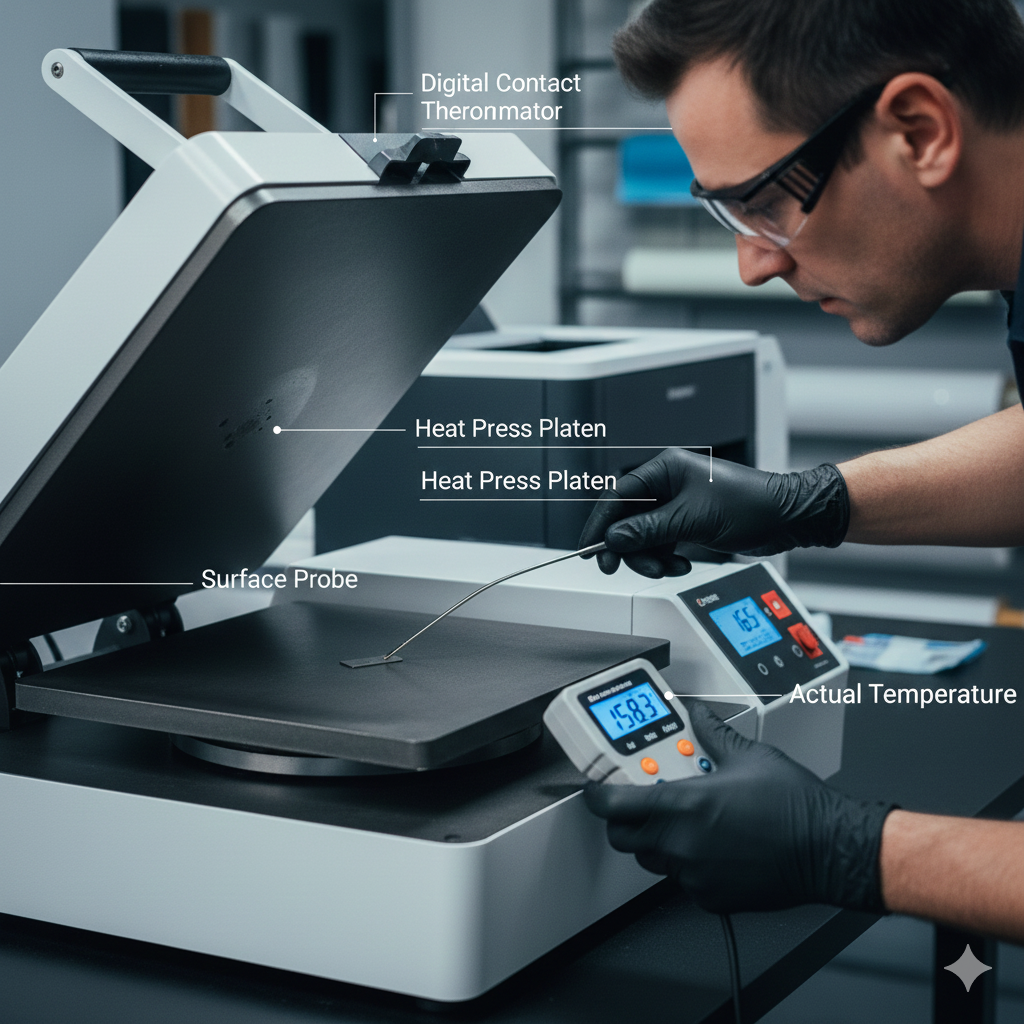
Technical Challenges: The “IR Thermometer” Trap
Many users attempt to calibrate using handheld Infrared (IR) thermometers, but this often leads to false readings due to Emissivity:
- What is Emissivity? It is the measure of a surface’s ability to emit infrared energy.
- The Problem: Heat press platens are often made of aluminum or coated in Teflon. These materials have low emissivity and reflect ambient infrared radiation.
- The Result: An IR gun may read 140°C when the platen is actually 160°C, leading the user to “calibrate” the machine incorrectly and overheat their garments.
Technical Recommendation: For accurate calibration, use thermo-labels (test strips). This method measure physical contact heat, bypass emissivity issues, and provide the most reliable data for the controller offset.
Frequently Asked Questions
Why does my heat press temperature not match my thermometer?
This is common due to thermal drift or sensor placement. Additionally, if you are using an infrared thermometer, the reading may be inaccurate due to the ’emissivity’ of the platen surface. A contact thermometer is required for an accurate reading.
How often should I calibrate my heat press?
Professional shops should check calibration every 6 months, or whenever switching to a highly sensitive transfer material like DTF or specialized sublibloc foils.
What is temperature offset in a heat press?
The offset is a setting in the heat press controller that allows you to add or subtract degrees from the display to match the actual measured temperature of the platen.
 4.7
4.7