
Concave refers to a surface that curves inward, resembling the interior of a bowl or a hollow sphere. In the context of vinyl application and signage, a concave surface is one where the center point is recessed further away from the installer than the edges. It is the geometric opposite of Convex.
Read more
Why It Matters: Impact and Use
Applying vinyl to concave surfaces is one of the most technically challenging tasks in the industry. Understanding how to manage these curves is a key indicator of E-E-A-T (Expertise, Authoritativeness, and Trustworthiness) in professional vehicle wrapping and architectural signage.
- Durability: Improperly applied vinyl in a concave area is prone to catching dirt and moisture at the lifting edges, which significantly reduces the lifespan of the graphic.
- Material Tension & “Popping”: When vinyl is pushed into a concave curve, it naturally wants to pull back to its original flat state. If the wrong material is used, the vinyl may “pop” out of the recess days after installation—a failure known as bridging.
- Cast vs. Calendered Vinyl: For concave surfaces (such as deep door handles or van recesses), a Cast Vinyl is essential. Cast vinyl has “no memory,” meaning once it is heated and stretched into a hollow shape, it stays there. Standard calendered vinyl has “memory” and will shrink back, causing the adhesive to fail.
- Technique (The “Deep-In” Method): Unlike convex curves where you stretch over the shape, concave surfaces require you to feed the material into the deepest part of the recess first to minimize tension on the edges.

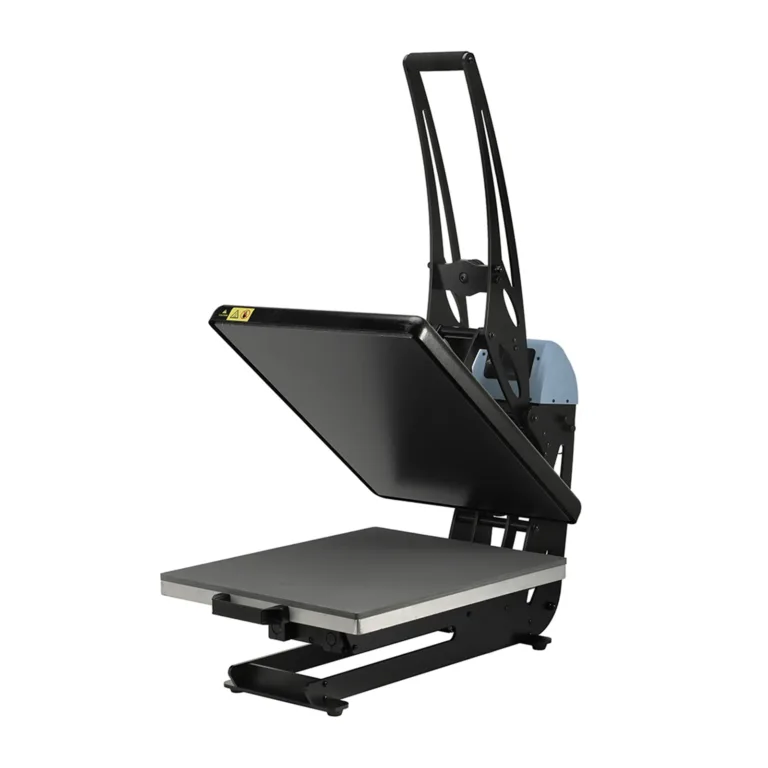
All clamshell Heat Presses
Comparison: Concave vs. Convex Application
| Feature | Concave (Hollow) | Convex (Rounded Out) |
| Visual Shape | Curves inward (like a cave). | Curves outward (like a ball). |
| Main Challenge | Lifting/Popping out of the recess. | Over-stretching and “whitening” of color. |
| Vinyl Choice | High-performance Cast Vinyl. | Cast or High-grade Polymeric. |
| Heat Requirement | High (for “post-heating” to kill memory). | Moderate (to increase flexibility). |
Frequently Asked Questions
What is the difference between concave and convex in vinyl wrapping?
Concave surfaces curve inward (like a bowl), creating a hollow that vinyl must be pushed into. Convex surfaces curve outward (like a ball), and vinyl is stretched over them.
Why does vinyl lift out of concave recesses?
Lifting, or ‘popping,’ happens because the vinyl’s ‘memory’ wants to pull it back to a flat shape. This is usually caused by using low-quality calendered vinyl or failing to post-heat the cast vinyl to 90°C+ to set its new shape.
What vinyl is best for concave shapes?
Premium Cast Vinyl is the only recommended media for deep concave shapes. It is thinner and more dimensionally stable than calendered vinyl, allowing it to conform to complex hollows without shrinking.
 4.7
4.7